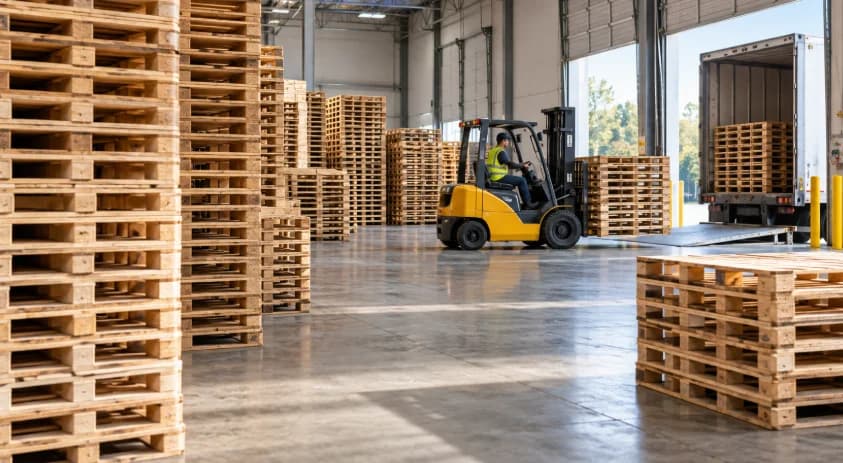
A warehouse should order pallets before inventory falls below the amount needed to cover normal usage, the next delivery cycle, and a practical safety buffer. For routine replenishment, starting the order process about one to two weeks before projected need gives procurement and receiving more room than waiting until the final few days. That is a planning cushion, not a guaranteed supplier lead time. At The Pallet Squad, our standard new, Grade A, and Grade B 48 x 40 wood pallets are listed as available for immediate delivery, but actual pallet lead times still depend on the order, location, volume, specifications, and delivery schedule.
The right timing becomes much easier to manage once a warehouse stops treating pallet orders as isolated purchases. Track how quickly pallets leave inventory, set a reorder point, and move the order date forward when demand or specifications change.
What Determines Pallet Lead Times?
Pallet lead times are not the same for every order. A warehouse buying a common 48 x 40 pallet on a normal schedule has a different procurement situation from a facility requesting a custom size for a large project.
Start with the pallet itself. Standard sizes and grades generally give buyers a simpler sourcing path. The Pallet Squad lists new 48 x 40 pallets, Grade A #1 48 x 40 pallets, and Grade B #2 48 x 40 pallets as available for immediate delivery through our pallet supply program.
Quantity matters too. A routine replenishment order should be planned differently from an unusually large order tied to a new customer, facility launch, promotion, or seasonal surge.
Delivery details affect planning as well. The destination, receiving hours, appointment requirements, and frequency all shape the schedule. If your operation has a narrow receiving window, build that constraint into the order rather than treating delivery timing as an afterthought.
Specifications are another factor. Custom dimensions, treatment requirements, construction type, and other order details need to be clear before sourcing begins.
Use a Reorder Point Instead of Waiting for Pallets to Run Low
A calendar reminder such as “order pallets every Friday” works only when usage stays predictable. Many warehouses see enough variation that a reorder point works better.
A useful reorder point should account for:
- Average pallet usage per day or week
- The inventory needed while the next order is being coordinated
- Extra stock for normal demand variation
- Known upcoming increases in shipping or production volume
For example, suppose a distribution center uses about 250 pallets per operating day. If the operation wants five days of working inventory plus a two-day buffer, the reorder point would be 1,750 pallets.
That number is not a universal recommendation. It simply shows how a facility can turn its actual usage into a purchasing trigger. A warehouse using 80 pallets per day should not copy the reorder point of a facility using 800.
Review the calculation whenever volume changes. A new account, extra shift, additional shipping lane, or seasonal rush can make an old reorder point obsolete quickly.
Order Custom and Export Pallets Earlier
Special specifications deserve more planning time because the warehouse has fewer interchangeable options if something changes.
If you need a size other than 48 x 40, our custom wood pallet supply starts with the specifications you submit for the order. Confirm dimensions, construction requirements, quantity, and use case before the pallets are needed on the floor.
Export shipments require another check. The USDA Animal and Plant Health Inspection Service explains that many destination countries require wood packaging material to comply with ISPM 15. Its guidance for exporting ISPM 15-compliant wood packaging material explains the treatment and marking requirements for compliant material.
If an outbound shipment requires compliant wood packaging, identify that requirement before placing the pallet order. Finding out after freight is staged creates a problem that better procurement planning could have avoided.
Move the Order Date Forward Before Peak Volume Hits
Warehouses often know about major volume changes before pallet usage actually spikes. Procurement should use that information.
Retail promotions, new customer launches, production increases, seasonal shipping periods, and facility expansions can all change pallet consumption. If outbound volume will rise next month, do not wait for the pallet count to fall at this month’s normal pace before adjusting the order.
Look at forecasted shipments alongside historical pallet usage. Then update both the quantity and the reorder point.
This is especially useful for facilities that have experienced the same seasonal pattern before. Last year’s pallet usage will not predict every detail, but it gives the team something more useful than guessing from the current stack.
A Loaded Drop Trailer Creates a Different Replenishment Rhythm
High-volume facilities may prefer keeping a larger pallet supply onsite rather than receiving smaller orders repeatedly.
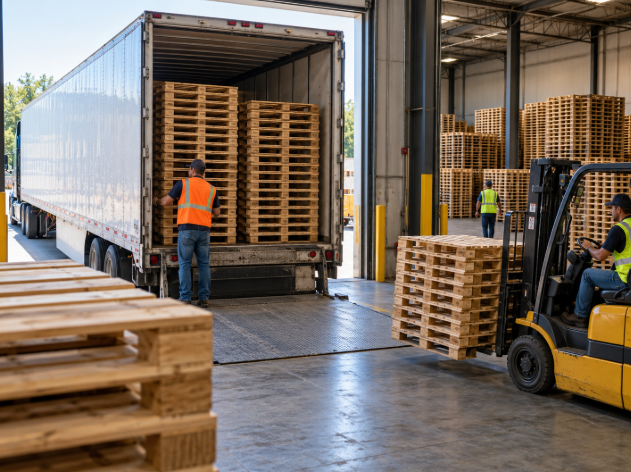
The Pallet Squad has a loaded drop trailer option for pallet supply. An enclosed 53-foot trailer arrives loaded with pallets and stays at the facility while the warehouse unloads inventory as needed. Our service information lists capacity at up to 600 pallets per trailer. As the trailer approaches empty, the warehouse places the next order and the trailer can be exchanged for a full one.
That setup gives the operation a visible reorder trigger. Instead of discovering that several pallet stacks are nearly gone across different warehouse areas, the team can monitor the remaining trailer inventory and plan the next exchange.
A loaded trailer still requires forecasting. If pallet consumption suddenly doubles, the same trailer will run down much faster. Track usage and trigger the next order based on remaining inventory rather than a fixed date.
Plan for Used Pallets at the Same Time
Pallet procurement is only one side of the warehouse flow. Facilities that receive and ship large volumes often accumulate used or unwanted wood pallets while they consume pallet inventory.
That buildup needs its own process.
For warehouses and distribution centers generating pallets continuously, our drop trailer pallet recycling service places a dedicated empty enclosed trailer at the facility. Warehouse staff load used pallets into it as they accumulate, and we coordinate removal and trailer exchange according to the service arrangement.
This setup works well for operations where pallet piles return soon after every pickup. A dedicated trailer gives receiving and warehouse teams a defined destination for those pallets instead of repeatedly creating temporary stacks around the dock or yard.
Treat supply and recycling as separate workflows, then plan them together. The purchasing team should know the inbound pallet requirement, while operations should know how quickly excess pallets accumulate. That creates a clearer picture of the facility’s total pallet movement and whether recurring drop trailer recycling makes sense long term.
What to Send With a Pallet Order Request
Good information reduces back-and-forth before an order is scheduled. Before you request pricing or delivery, gather the details the supplier needs to understand the job.
Include your delivery location, pallet size, grade or construction type, approximate quantity, desired delivery timing, and whether the need is one-time or recurring. If you are interested in a loaded supply trailer or an empty recycling drop trailer, include that too.
For recurring orders, share expected frequency and any known changes in volume. A warehouse that normally needs pallets monthly but expects a six-week peak should say so upfront.
Receiving details matter as well. Note appointment requirements, dock constraints, operating hours, or other information that affects delivery.
Build Pallet Lead Times Around Actual Warehouse Usage
There is no single pallet order lead time that fits every warehouse. Standard 48 x 40 inventory, custom specifications, order volume, delivery requirements, export needs, and changing demand all affect how early the process should start.
The strongest approach is to know your normal usage, establish a reorder point, keep a reasonable buffer, and adjust before known volume increases. High-volume facilities should also look at how pallets enter and leave the building. Loaded drop trailers support recurring pallet supply, while empty drop trailers create an ongoing pallet recycling process for facilities that accumulate used pallets continuously.
If your warehouse is planning regular pallet supply, a drop trailer for pallet inventory, or ongoing pallet recycling with a drop trailer, request a quote from The Pallet Squad. Include your location, pallet specifications, quantity, frequency, and expected timing so we can evaluate the service need accurately.