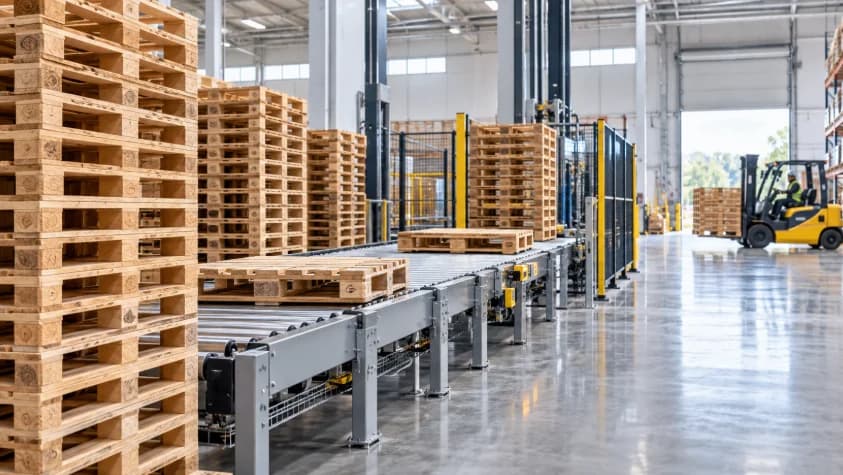
Choosing pallets for automated warehouses starts with the equipment specification, not the grade label. Grade A recycled pallets are often a stronger starting point when an operation needs consistent condition and fewer repairs, while Grade B may fit applications that allow repaired pallets. Some systems may require new or custom wood pallets instead. The important part is confirming dimensions, construction, entry style, condition, and equipment requirements before placing the order.
At The Pallet Squad, we supply new, Grade A, Grade B, and custom wood pallets nationwide. For facilities using conveyors, automated storage systems, wrappers, or other equipment that interacts directly with the pallet, the purchase specification needs to go further than simply saying “Grade A” or “Grade B.”
Why Pallets for Automated Warehouses Need a Clear Specification
A forklift operator can respond to small differences between pallets. Automated equipment follows the parameters it was built and programmed to handle.
That makes consistency especially important.
Two pallets may both be classified as 48 x 40 Grade A pallets while still having differences that matter to a specific piece of equipment. The warehouse needs to know what the conveyor, palletizer, wrapper, storage system, or other equipment expects before purchasing inventory.
Start with the equipment manufacturer’s pallet requirements. Those requirements may address overall dimensions, pallet orientation, entry configuration, board placement, allowable damage, or other construction details.
The National Wooden Pallet & Container Association’s Uniform Standard for Wood Pallets provides industry guidance for wood pallet manufacture, repair, purchase, and use. A warehouse should still document the requirements of its own equipment rather than assuming that a general pallet grade automatically meets them.
Where Grade A Pallets Fit
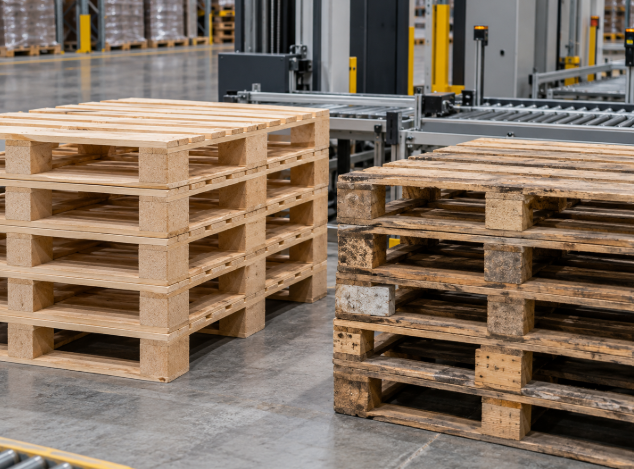
The Pallet Squad classifies our 48 x 40 Grade A #1 pallets as our highest-quality recycled pallet. These pallets have no stringer repairs and generally show less visible wear than Grade B inventory.
That makes 48 x 40 Grade A pallets worth evaluating when an automated operation accepts recycled wood pallets but needs a tighter condition standard.
The lack of stringer repairs removes one variable from the pallet. A cleaner and more consistent recycled pallet may also simplify receiving inspections when the warehouse already has strict acceptance criteria.
Grade A still should not serve as shorthand for “automation approved.”
Before ordering, compare the pallet specification with the actual equipment requirements. Confirm the footprint, entry type, deck configuration, allowable repairs, and other details the system needs.
If the automation vendor provides a written pallet specification, use that document when requesting quotes.
Where Grade B Pallets May Still Work
Grade B is a recycled pallet category that allows more repair history.
Our 48 x 40 Grade B #2 four-way pallets may include repaired stringers and replacement boards. They are used for routine shipping, storage, and warehouse operations where that condition fits the application.
That does not automatically rule Grade B out of a facility that uses automation.
A large distribution center may have several different pallet environments. One area may move pallets through tightly controlled automated equipment, while another relies on forklifts and pallet jacks for standard handling. The warehouse does not necessarily need the same pallet specification in both places.
If repaired pallets meet the equipment requirements in a particular area, Grade B may remain an option. If the automation specification limits certain repairs or construction differences, purchasing needs to follow that requirement.
Separate those uses clearly. Employees should know which pallet inventory belongs on automated lines and which pallets belong in other warehouse applications.
Grade Does Not Tell You Everything Automation Needs to Know
A pallet grade describes condition, but warehouse equipment interacts with the physical pallet.
That means purchasing teams need to look beyond the grade name.
A complete specification may need to address:
- Overall pallet dimensions
- Two-way or four-way entry
- Stringer or block construction
- Top and bottom deck configuration
- Acceptable repairs
- Missing, loose, cracked, or damaged boards
- Fastener condition
- Pallet flatness and visible distortion
- Customer-specific requirements
- Load and handling requirements
The exact list depends on the facility.
Avoid copying another warehouse’s pallet specification simply because it uses similar equipment. Conveyor systems, palletizers, storage systems, racking, product loads, and handling methods differ.
The people responsible for the equipment should tell procurement what the system requires. Purchasing can then use those requirements when sourcing pallets.
When New or Custom Wood Pallets Make More Sense
Some operations need more control over the pallet specification than a standard recycled grade provides.
The Pallet Squad supplies new 48 x 40 wood pallets and custom wood pallets for businesses with specific requirements.
A custom specification becomes relevant when a standard pallet footprint, construction, or configuration does not match the load or equipment. The same applies when an operation has documented requirements that go beyond a normal Grade A or Grade B description.
Do not move to a custom pallet simply because the warehouse has automation. First confirm what the equipment actually requires.
A standard pallet may already fit the operation. Another system may need a much narrower specification.
Get that answer before comparing prices.
Test the Pallet Before Scaling the Order
A high-volume warehouse should avoid finding a compatibility problem after a large order reaches the dock.
If the operation is changing suppliers, pallet specifications, equipment, or grade, establish an approval process before scaling the program.
Receiving and operations teams should inspect the pallet against the written specification. Where appropriate, the facility can also evaluate how the approved pallet moves through its normal process before making it the standard for recurring purchases.
Document what employees should reject.
A pallet that does not meet the warehouse specification should not remain mixed into approved inventory where another employee may accidentally return it to circulation.
Keep rejected pallets in a clearly identified location until the facility decides whether they belong in another approved application, need supplier review, or should enter the appropriate recycling process.
Separate Pallet Standards by Warehouse Use
Mixed operations often benefit from more than one approved pallet category.
The automated portion of the building might follow one specification. Manual staging or internal transfers may use another. Outbound customers may have their own pallet requirements.
That approach keeps the warehouse from paying for a tighter pallet specification where it does not serve a purpose.
It also prevents employees from sending the wrong pallet into a process that requires a different configuration.
Clear storage locations matter here. If several grades or specifications sit in the same area, employees eventually have to identify them during a busy shift. Separate stacks and clear inventory descriptions make the choice much easier.
Purchasing should track consumption separately as well. A warehouse may have plenty of total pallet inventory while running short on the specific pallets approved for its automated line.
Have a Plan for Pallets That Leave Active Use
Automated warehouses still generate used, damaged, excess, or incompatible pallets.
Those pallets need somewhere to go.
If employees place every rejected pallet beside the line or behind receiving, the facility eventually creates another material-handling problem. Pallets get moved from one temporary area to another while the stack grows.
High-volume operations that continuously generate unwanted wood pallets should consider building recycling into the normal warehouse workflow.
Our drop trailer pallet recycling service places an empty enclosed 53-foot trailer at qualifying facilities. Warehouse personnel load approved unwanted pallets into the trailer as they accumulate. When the trailer reaches the appropriate service point, we coordinate removal and exchange according to the service arrangement.
The listed trailer capacity is up to 600 pallets, although the actual amount depends on pallet size, mix, and loading method.
For an automated facility, that creates a useful separation between active pallet inventory and pallets that have already left circulation.
Employees know which pallets belong in production or shipping and which approved unwanted pallets are moving toward recycling.
Connect Pallet Supply and Pallet Recycling
Warehouse pallet management works better when inbound supply and outgoing excess are both visible.
Track how many pallets the facility uses, which grades or specifications each area requires, and how many pallets leave active circulation over the same period.
That information tells purchasing what to replenish. It also tells operations whether used pallet accumulation has become consistent enough to require recurring pickup or a drop trailer.
A facility might discover that Grade A inventory turns quickly through an automated shipping area while damaged or incompatible pallets accumulate steadily on the other side of the building.
Treat those as connected workflows.
The Pallet Squad provides nationwide pallet supply along with pallet pickup and drop trailer recycling. For high-volume warehouses, a defined supply program paired with a repeatable recycling process reduces the need to solve the same pallet problem every few weeks.
Choose the Pallet Around the Equipment
There is no universal pallet grade that works for every automated warehouse.
Grade A is a practical recycled option to evaluate when the operation wants fewer repairs and more consistent condition. Grade B may fit warehouse applications that accept repaired pallets. New or custom pallets become relevant when the operation requires a specific construction or configuration that standard recycled inventory does not provide.
Start with the equipment specification. Then match the pallet to it.
If your facility also produces a steady volume of used or unwanted wood pallets, plan the outgoing side at the same time. A recurring pickup or drop trailer recycling program gives those pallets a defined destination instead of allowing rejected inventory to collect around the warehouse.
To discuss pallet supply or ongoing pallet recycling, request a quote from The Pallet Squad with your location, required pallet specifications, approximate quantity, delivery frequency, and the volume of used pallets your facility generates.